
| (818) 730-8203 Copyright ©2010-2018 Rocky Peak Leadership Center |       |
| (818) 730-8203 Copyright ©2010-2018 Rocky Peak Leadership Center | |
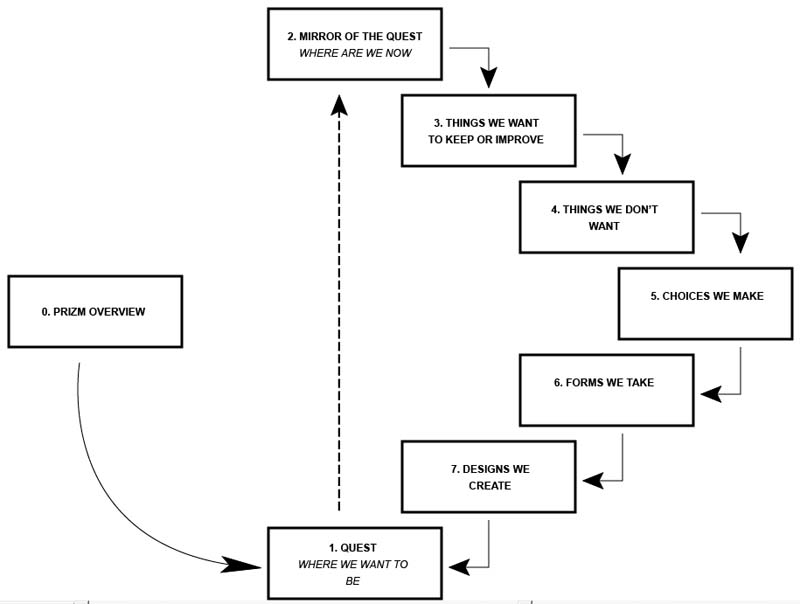
| 0.0 Overview: PRIZM is a systemic and process based innovation process played as a game to create new ideas formulated as stories. It is a board game format that 3-5 participants sit around and follow seven timed steps to complete. The game starts with a Quest, which is the solution to a problem or an issue. Similar to idealized design, you start the first step of the game with the end in mind. Game participants are then channeled through a series of steps constructed to allow a cognitive decomposition of the problem into the “Who”, “What” and “Where” to expose interconnected influences and connected functions. The game encourages the use of the best thinking steps for divergence, and convergence activities: exploring possible solutions based upon science, biology, design and harmonics with a deck of card ideas, which embrace STEM design features and characteristics from previous proven design solutions. The natural flow of the game allows collaborative synergies focused on achieving the game quest. Games are timed and easy to play which allows everyone to become engaged participants. Working as a team of 3-5 players with a common goal eliminates adversarial thinking and opens dialogue where one idea can build upon another ultimately creating a fun and natural flow of expression. After the ideas are repopulated or separated into five areas of materials and structures, coordination, internal control, relationships and applications a series of three stories are created by the game participants. Stories are the backbone to the PRIZM process; it is the movement of defining transformational aspects within a narrative to dissect a problem into an understanding of the ideal state. This reassembled advance offers a mosaic of possibilities. A PRIZM story contains a composite of integrated ideas which examine both the ideal and present state through a relatable focus. Exploration through game context creates a meaningful framework for organizing the participants thoughts and idea creating process. Game Playing teaches you a strategy which is a process for structuring innovation divergence and convergence models and creating/conceptualizing ideas while having fun. This is an integration of learning objectives into gameplay. Throughout social and behavioural science discourse on social and cognitive development, gameplay is regarded as an important arena for the development and formation of critical thinking, team decision making and communication. This teamwork and collaboration, not competition creates a cooperative environment and a positive adaptive learning process to explore innovation and idea creating. |
| 2.0 Mirror Image of the Quest: The second step in the PRIZM game process is the development of the “Mirror Image of the Quest”. A Mirror Image of the Quest reveals a reflection of the current situation conceptually constructed from the original Quest. It is a companion Quest description of where we are now including all of the limitations, problems and perceptions. To create the Mirror Image of the Quest you should document the features and elements of the current system, situation, or object as it exist right now, at this moment in time. It should include all of the positive attributes and deficiencies that are collectively known. This step is one of the most difficult in the process because we are moving from a place of imagination into a place of analysis. This documentation should mirror and take into account all of the key characteristics of the original Quest you can think of so that you can understand exactly where you are starting from. Just like looking in a mirror you see a reflection that is Identical to the other except it is reversed. We want to create a current view of the who, what, where, when and how composition of the current scenario context awareness which we call our “Mirror Image of the Quest”. • What – The Object(s) or element(s) that exist in the current system • Who – The Person(s) or group(s) that exist in the current system • Where – The Place(s) or space(s) that exist in the current system • When – The Time(s) or season(s) that exist in the current system • How – The Function(s) or connection(s) that exist in the current system By combining our collaborative mental prowess, we can create an objective context which allows us to communicate written statement descriptions of what is helping or hindering our goals. This is essential for both dissection and documentation of our generated ideas. No international system of water governance exists. Water is owned by individual nations whose individual agendas usually only are collaborative to their financial stakeholders. Water Governance in the United States is controlled by PoWG and transboundry issues exist with Canada and Mexico. Current goals are to support water “clean water” but potable standards are different in different US states . Industrial water is monitored and controlled by the national standards of the EPA effluent guidelines. California agricultural water control is covered by the California Department of Food and Agriculture and partnerships for salinity control with the California aqueduct water flow from the Sierra Nevada mountains and is pumped and channeled by DWR to Central and Southern California. Water re-use management in California is also controlled by DWR. Individual states have individual control over their own natural resources. Water moving through the aqueduct system is used to generate electricity as it moves through dams and generating locations. In years of drought water flow is lowered to support only minimal flow leading to reduced energy creation. Leaks and breaks in the flow and drainage systems exist in the water transfer and transportation systems leading to delivery systems to agricultural growers. No smart technology exist to identify leaks, overuse or misuse. |
| 3.0 Things we want to keep or improve The third step in the PRIZM game process is the construction of the “Things we want to keep or improve”. In other words we want to plan from where we are moving to where we want to be. The Things we want to keep or improve is the 1st step in the innovation divergence process for identification of the positive system elements, components or things we have inside the “Mirror image of the Quest”. These Things that we want to keep or improve are separated into three categories defined as WHAT, HOW and WHERE. Everything in the known universe has these three attributes, things always “do things” somewhere! When probing or investigating, “Questions” for how, where, and what that can help you identify, analyze, synthesize and evaluate the current situation. The word question, stems from the Latin word quaerere (to ask, to seek). Just as ancient heroes would go on a quest, you are on a quest for meaning and understanding when you ask questions. Questions make you a participant in the active request for information. A great question should be well-timed and carefully formed to test and pinpoint problem areas to facilitate further investigation and study of the problem. PRIZM Questions are used to identify the positive features in the system that we want to keep. These can be people, processes, places, things, behaviors and functions. Additionally we identify any of those areas that we want to improve. You need to fill all three boxes with answers to these questions as a single word or phrase on a post-it note. You can deconstruct the information also by asking “WHO or what DOES WHAT to whom or WHERE?” Sample Statement – “THE CAT SAT ON THE MAT” WHAT = CAT HOW = SAT WHERE = THE MAT |
| 4.0 Things we don’t want The forth step in the PRIZM game process is to create ‘Things we don’t want”. These are negative aspects of the “Things we wanted to keep or improve” What, How and Where descriptions that we want to remove from the system. These are broken down into a material, function and environment separations that keep us from getting what we want. Things we don’t want are the 2nd step in the innovation divergence process and are where we explore a problem as a contradiction. Contradictions are conflicting situations inside a system which cause problems. These conflicts or contradictions inside a system can restrict the performance of the system. A contradiction occurs when we have a situation, in which inherent factors, actions or propositions create two directly opposing ideas. A “Round Square” is a simple example of a contradiction. Almost all contradictions create conflict with two different parameters, which means by improving one parameter of the system it causes deterioration of the other parameter. • An example of a “material” contradiction is something that must be stiff and ridged but also flexible to bend. • An example of a “function” contradiction would be that something needs to go fast and slow at the same time. • An example of an “environment” contradiction would be something needs to be hot and cold at the same time. In this PRIZM innovation process step you take each of the post-it notes from the previous step in the WHAT category and identify the things we don’t want from each one by asking all three questions. Write that word or statement down on a new post-it note and place it in the correct box. After you have identified the WHAT materials or structures stop us form being happy you move to the HOW are we stopped by being happy with our functions, actions or behaviors. Finally you move into the WHERE in the environment, space or time are we stopped from having what we need. |
| 5.0 Choices we make The fifth step in the PRIZM game process is the construction of “Choice we Make”. These Choices are the transformation step of idea creation in the PRIZM Innovation game. The PRIZM Game board has nine colored spaces where 62 individual PRIZM game cards are placed. These game cards are separated by color onto the corresponding spaces and are used as idea triggers to replace “Things we don’t want” from the previous step. The cards are used as random stimulus idea triggers which have two different aspects, the first is the visual trigger from the color picture image on one side and the other is the patterning trigger from a statement of words on the reverse side. This statement has been successful in the past to create a design solution associated with this specific problem or issue. These cards represent ideas that can be created using Science, Technology, Engineering, Math (STEM), Biology, Nature and Environmental previous design solutions that can help create a different way to conceptualize things and break out of existing patterns. The gameplay purpose of the cards is to allow the participant to start at the top of the red stack of cards to help players and teams to brainstorm new solutions to “Things we don’t want”. Start with the “WHAT” and move through all of the “Material”, “Function” and “Environment” deficiency statements one by one. Then move on the “HOW” and “WHERE” sections until all cards have been used. Ideas should be written on a small piece of sticky-note paper and adhered to the game card replacing it back into the originating color card pile. There are duplicate cards in some of the color card piles because previous successful ideas have been generated using those idea triggers. Each idea should be read out loud to the game participants to make sure it contains enough clarity and detail to be understood by everyone. If the idea needs additional refinement, asking the participant idea generator to “Tell me more” and documenting that will continue to refine the concept. At times it may be required for someone to create a small sketch or drawing to accompany the words because “a picture is worth a 1000 words” and a complex idea can be conveyed with just a single still image. You should explain to the game participants that they are to come up with a creative solution to the problem or contradiction, using the words on the cards as focus inspired by the idea triggers on the cards. Reveal the cards one at a time (typical gameplay) – or as a series (advanced gameplay) depending on the type of PRIZM game being played. |
| 6.0 Forms we take The sixth step in the PRIZM game process is the construction and convergence of the “Forms we take”. The “Forms” are the 1st step in the innovation convergence process. These Forms are broken down into 5 separate categories for Material & Structures, Coordination, Internal Control, Relationships and Integrity & Added Applications. These (5) categories represent a complete system description and can be used as separation boxes for all of the idea-post-it notes on top of the PRIZM idea cards. You start at the top of the ideas generated from the “Choices we make” Red color space and move them into any one of the categories that best fits by description and understanding of the idea statement. You repeat this process and move on to the Orange, Yellow, Green, Blue, Purple, Brown, White and finally the Black color space. The “Idea Park” wildcards cards are now reviewed to determine if they fit into this games “Quest” – if so they are added into the appropriate Forms we take category. If they do not fit with this “Quest” they are place to the side for review at a later time. The process for moving ideas into the categories should be a collaborative effort agreed to bay all game play members. Read the ideas out loud to make sure there is a clear understanding of the idea statement. If there confusion or ambiguity in the meaning of the idea it needs to be clarified by adding additional detail or structure. If necessary a sketch drawing or mini design can be constructed to accompany the idea. Everyone who is playing the game should be able to completely understand the new idea statements. Now that all of the ideas have been moved into the categories you should always have at least a minimum of three (3) cards in each area. |
| 7.0 Designs we create The final step in the PRIZM game process is to assemble 3 different “Designs we Create” in story form. This is accomplished by taking the ideas that were collected and reconstruct them into a format that flows and connects into a positive narrative description of a situation. Once the ideas have been categorized and separated into the 5 “Forms We Take”, a subset of them are transferred to the “Designs we Create” to illustrate three (3) independent stories. Start with the Material and Structures ideas and separate them individually into the area that fits the best for a Cheap, Simple or Beautiful Story. Repeat the process until you have the best ideas from each of the “Forms” inside the (3) stories. As a minimum you want to move 1 idea from each of these “Forms” over into the stories game locations. This will allow you to start construction of a story with at least 5 key ideas. These ideas are woven together to create a collaborative description of characters, new elements, design solutions, unique situations and resolved contradictions taking an audience on a desired journey to the resolution and fulfillment of some human need to matter. The crafting of PRIZM Stories are a way to create a sense of meaning and purpose taking the game players to a “place” where problems can be solved, negative situations can be overcome in a positive way and unique and novel solutions can be constructed. |
| 1.0 Quest: The first step in the PRIZM game process is the development of the “Quest”. A quest is all about seeking something important, and it involves a journey, sometimes with a great, but attainable distance. For example, you would travel the world in a quest for gold. You would not travel to the front of the school lunchroom in a quest for a peanut butter and jelly sandwich. There can be a mysterious and holistic connection to an inner world beyond everyday physical reality. A conceptual pathway where anything can be possible. It is used to gain clarity, define, find and explore patterns through a process of simplification which can create a sense of wonder and connection opening your mind. A PRIZM Quest is an adventure with a mission containing details about the context and the background. To create a Quest you must envision a “Journey” to a place, destination, situation or thing that does not currently exist. It must be narrow enough for you to have some level of control over it and it should represent an ideal final result. You should visualize an ideal solution that leverages advantages of the current system while disregarding any deficiencies. To accomplish this requires you to compose what the best possible solution to a problem, situation or contradiction is, regardless of the resources or constraints of the original problem. It is a positive mental “Journey” towards the discovery of a desired goal identifying the key resources or characteristics associated with its function, performance or operation in a perfect world. As a minimum it should contain a brief description of the who, what, where, when and why composition of a perfect scenario allowing us to live life more genuinely and courageously. This pathway feels right and is used to gain clarity to overcome the psychological law of inertia creating what is called a PRIZM “Quest”. “To create an international open source system of water governance that is comprehensive and health promoting for all life, useable for all water requirements and integrated from consumption to re-use”. |